







What is gigabit broadband?
Gigabit broadband describes internet connections capable of delivering speeds of around one gigabit per second (1Gbps).
That’s approximately 1,000 megabits per second (Mbps), although providers often advertise average package speeds slightly below this figure.
Gigabit broadband can deliver very fast downloads and support demanding household internet use.
However, the actual speeds you’ll experience depend on your connection, equipment and the services you’re using.
Gigabit packages are available over several broadband technologies, including full-fibre and cable networks.
How fast is 1Gbps broadband?
A gigabit connection has the capacity to transfer substantially more data per second than a typical entry-level broadband package.
This can be particularly useful for downloading large games, software updates, high-resolution video files and other substantial amounts of data.
However, the maximum broadband speed doesn’t guarantee that every download will reach that rate.
Performance can be limited by the server you’re downloading from, the device you’re using, your home network or other simultaneous activity.
Does gigabit mean 1,000Mbps?
Broadband speeds are usually measured in megabits per second.
One gigabit per second is 1,000Mbps.
However, a package marketed as gigabit broadband may have a lower advertised average speed, such as around 900Mbps.
This can still be considered gigabit-class broadband.
Is 2Gbps broadband twice as fast?
A 2Gbps connection has approximately twice the headline capacity of a 1Gbps connection.
However, individual downloads and devices won’t automatically operate twice as quickly.
To achieve speeds above 1Gbps on a single device, you’ll generally need suitable multi-gigabit network equipment and a service capable of delivering data at that rate.
For many households, a faster connection mainly provides additional shared capacity rather than a dramatic improvement to everyday browsing.
Do you really need gigabit broadband?
Most households don’t need gigabit speeds for ordinary internet activities.
Browsing websites, sending emails, video calling and streaming television generally use much less bandwidth.
However, gigabit broadband can be worthwhile for particular households.
Large households with many devices
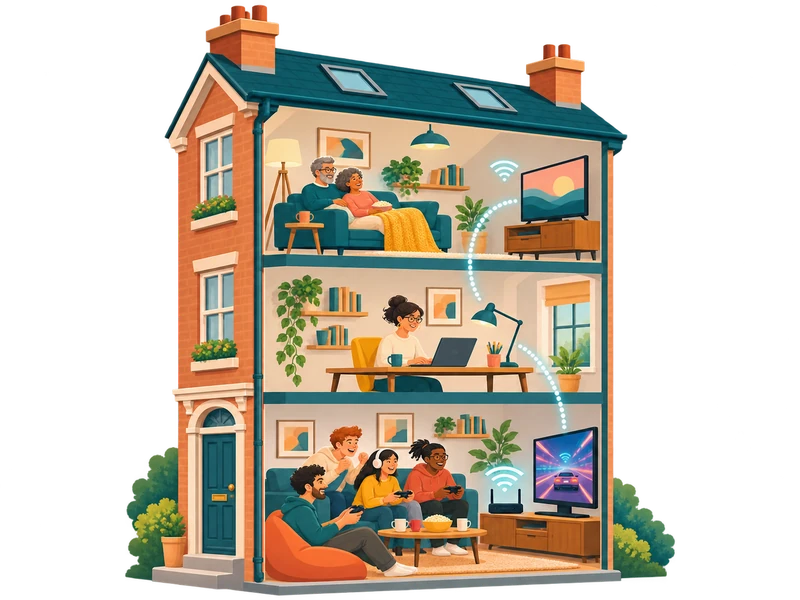
If several people regularly stream, download, game or work online simultaneously, gigabit broadband provides substantial shared capacity.
This can help prevent large downloads from consuming most of the available bandwidth.
Frequent large downloads
Gigabit broadband can significantly reduce the time required to download large game updates, software packages or other files, provided the download source and equipment can keep up.
Working with large files
Households regularly transferring large files may benefit from faster broadband.
However, upload speed is especially important for sending files to cloud storage or remote servers.
A gigabit download connection doesn’t necessarily provide gigabit upload speeds.
Enthusiasts and high-demand users
Customers operating demanding home networks, using large amounts of cloud storage or regularly transferring substantial amounts of data may value the extra capacity.
However, it’s worth checking whether individual devices can take advantage of the speed before paying for a premium package.
Is gigabit broadband better for gaming?
Gigabit broadband can make downloading games and updates much faster.
However, online gameplay usually requires relatively little bandwidth compared with downloading a game.
Latency, jitter, packet loss and connection stability are more important for responsive online gaming.
A fast connection can help if several people share the household broadband, but it doesn’t automatically guarantee a lower ping.
A stable Ethernet connection may provide a more consistent gaming experience than Wi-Fi, regardless of the package’s headline speed.
See our broadband for gaming comparison for more information.
Does gigabit broadband improve 4K streaming?
Gigabit broadband provides far more capacity than is required for a single 4K video stream on most services.
It can be useful in a large household where several people stream high-resolution content simultaneously.
However, moving from a suitable 100Mbps or 300Mbps connection to 1Gbps may not noticeably improve the picture quality of an individual stream.
Streaming services adapt their quality according to connection conditions, device capabilities and content availability.
Choose a package based on your household’s overall needs rather than assuming gigabit is necessary for 4K television.
Which networks offer gigabit broadband?
Openreach full fibre
Openreach operates a national FTTP network used by several retail broadband providers.
Where gigabit-capable infrastructure is available, customers may be able to order faster packages from BT, EE, Vodafone, Sky and other providers.
The available speeds and prices depend on the retailer.
CityFibre
CityFibre operates an independent full-fibre network in selected areas.
Retail providers using its infrastructure can offer gigabit-class broadband, with upload-speed arrangements that differ between products and networks.
Virgin Media
Virgin Media offers gigabit-capable broadband over its cable and full-fibre infrastructure.
However, its network includes different technologies, so upload performance and equipment can vary by address.
Not every Virgin Media gigabit connection is FTTP.
Independent full-fibre networks
Providers such as Hyperoptic, Community Fibre, Gigaclear, KCOM, Trooli, YouFibre and Zzoomm offer gigabit or faster services in supported areas.
Some independent networks also offer symmetrical speeds or multi-gigabit packages.
Availability is restricted to the properties connected to the relevant network.
What is the difference between gigabit and full-fibre broadband?
Gigabit refers to connection speed, while full fibre describes the technology used to connect a property.
FTTP can support gigabit and multi-gigabit broadband, but it can also provide much slower packages.
Conversely, some cable broadband connections can deliver gigabit-class download speeds without using fibre-optic cabling all the way into the home.
If you’re specifically looking for FTTP, check the connection technology rather than relying solely on the advertised speed.
Explore our full-fibre broadband deals for more information.
Are gigabit upload and download speeds the same?
Not necessarily.
Some full-fibre providers offer symmetrical broadband, with similar advertised upload and download speeds.
Other providers offer significantly faster downloads than uploads.
This difference can matter for remote working, cloud backups, uploading video and sharing large files.
For example, two packages with similar gigabit download speeds may provide very different upload performance.
Check both figures before ordering.
Do you need a special router for gigabit broadband?
To take full advantage of gigabit broadband, your networking equipment needs to support the connection speed.
Most modern broadband routers supplied with gigabit packages are designed to handle the advertised service.
However, speeds experienced by individual devices may be lower because of Wi-Fi limitations, router settings or network equipment.
Ethernet connections
A wired Gigabit Ethernet connection can provide high speeds with relatively consistent performance.
However, its practical throughput is usually below the nominal 1Gbps link rate because of protocol overhead.
For connections above 1Gbps, compatible 2.5GbE or faster Ethernet ports may be required.
Wi-Fi 6 and Wi-Fi 7
Modern wireless standards can support high-speed home networking, but actual Wi-Fi performance depends on the router, connected devices, channel conditions and distance.
Wi-Fi 7 can be particularly useful for advanced home networks, although both the router and connected devices must support it to benefit from its features.
A gigabit broadband contract doesn’t guarantee gigabit speeds on every wireless device.
Mesh Wi-Fi systems
Mesh systems can improve wireless coverage in larger homes.
However, additional mesh equipment doesn’t increase the speed of your broadband connection.
Depending on the equipment and placement, wireless links between mesh units may also reduce the speed available to individual devices.
What about multi-gigabit broadband?
Multi-gigabit broadband refers to services faster than 1Gbps.
These may include 2Gbps, 2.5Gbps and other high-speed packages in supported locations.
Such connections can be useful for demanding households or users with advanced networking requirements.
However, benefiting fully may require multi-gigabit routers, compatible Ethernet ports, suitable cabling and powerful devices.
For many ordinary households, a well-performing gigabit connection already provides substantially more capacity than they regularly use.
How much does gigabit broadband cost?
Gigabit broadband prices depend on the provider, network, contract length and any introductory promotions.
In some areas, competition between full-fibre networks makes gigabit packages relatively affordable.
In others, gigabit broadband may cost considerably more than a 100Mbps or 300Mbps package.
When comparing deals, consider the initial monthly charge, scheduled increases, setup fees, equipment and total minimum-term cost.
Also check whether premium Wi-Fi equipment or additional services are included.
The fastest available connection isn’t necessarily the best value.
Can you get gigabit broadband at your address?
Gigabit availability depends on the physical networks connected to your property.
Even if your postcode is within a full-fibre coverage area, an individual building may not yet be connected.
Some providers also restrict their fastest packages to particular network areas or equipment configurations.
Use the postcode checker above and select your address where available to see which participating providers may offer gigabit-class broadband.
Always confirm final availability and speed information with the provider before ordering.
Is gigabit broadband worth it?
Gigabit broadband can be excellent for busy households, large downloads and people with demanding internet requirements.
However, there is little benefit in paying substantially more for speed you rarely use.
If your current connection comfortably handles your household’s activities, upgrading may not provide a noticeable improvement to everyday browsing, streaming or video calls.
If gigabit broadband costs only slightly more than a slower package, the additional capacity may be attractive.
Compare the total contract cost and upload performance, not just the headline download speed.
Compare gigabit broadband deals
The comparison table above shows gigabit-class packages from participating broadband providers.
Check which connections are available at your address, then compare average download speeds, upload performance, contract length and total costs.
Consider whether your existing router and devices can make use of the available speed.
The best gigabit deal provides the capacity you need without paying unnecessarily for equipment, features or speed your household won’t use.
Gigabit broadband FAQS
What is gigabit broadband?
Gigabit broadband describes internet connections offering speeds around 1Gbps, equivalent to approximately 1,000Mbps. Providers may advertise average speeds slightly below this figure.
Is 1Gbps broadband worth it?
It can be worthwhile for large households, frequent downloaders and demanding internet users. However, most everyday activities don’t require gigabit speeds.
Is 1Gbps faster than 900Mbps?
Yes, in terms of maximum connection capacity. However, the real-world difference may be small for many activities, and actual speeds depend on equipment and network conditions.
Do you need full fibre for gigabit broadband?
No. Gigabit-class downloads are available over some cable networks as well as FTTP. However, the connection technology and upload performance can differ.
Does gigabit broadband improve gaming?
It can reduce game download times and provide more capacity for shared households, but it doesn’t automatically improve latency or reduce ping.
Can Wi-Fi deliver gigabit speeds?
Some modern Wi-Fi equipment can achieve gigabit-class speeds under suitable conditions, but performance depends on the router, connected device, interference and distance.
What is multi-gigabit broadband?
Multi-gigabit broadband refers to connections faster than 1Gbps, such as 2Gbps or 2.5Gbps. Compatible networking equipment may be needed to benefit fully.
Is gigabit broadband available everywhere?
No. Availability depends on whether your property is connected to a compatible network and whether the provider offers gigabit packages at that address.