


Have in-car communications peaked?
In-car communications have come a long way, but it’s doubtful there’s much further for this technology to go.
Until the turn of the millennium, car interiors were largely technology-free zones.
Austin-Rover had experimented with voice synthesisers in the Maestro, Fiat fitted digital dashboards in early Tipos and trip computers graced various Granadas and Senators.
Beyond car phones, there was no other consumer technology in cars, and even satellite navigation was only found on a handful of flagship models in 2000.
How times change.
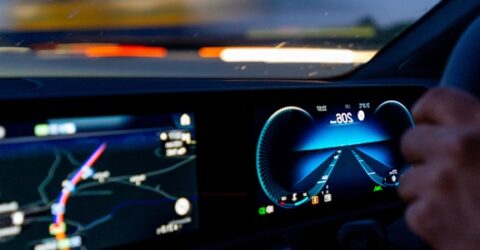
Today, car dashboards resemble iPads. Traditional dials and buttons are being swept away by a touchscreen revolution that governs almost everything we do behind the wheel.
At the same time, smartphone mirroring enables Android and iOS apps to be accessible whenever we’re in our vehicles.
With Bluetooth wireless connectivity baked into even budget superminis, phone calls on the move have long since lost their novelty.
The rapid rate of technological progress might suggest a near-future where our cars, smartphones, home broadband and public WiFi networks all seamlessly interact.
The reality might be rather different…
Too much of a good thing
Because touchscreens are cheaper for manufacturers than buttons and dials, traditional controls have been systematically erased from car interiors.
In many Teslas, even the indicators are controlled by a touchscreen, which is fun on a double mini-roundabout.
Something as simple as turning off a car alarm can involve several sub-menus, as can deactivating the wealth of EU-mandated safety equipment (if it can be switched off at all).
These driver ‘assistance’ systems aren’t required in Britain, but manufacturers have chosen not to modify UK-market vehicles, instead selling us what European buyers receive.
Consumers are increasingly tired of being endlessly beeped at by their cars, often because of inaccurate or irrelevant information such as incorrect traffic speed alerts.
Once you connect your smartphone (usually wirelessly, though some vehicles require a USB cable), the plethora of notifications rises with every app alert, SMS, email or WhatsApp.
Meanwhile, our roads are drowning in variable speed limits, average-speed cameras, bus lanes, potholes, traffic calming, ULEZ zones, militant cyclists, LTNs, ‘smart’ motorways…
Peak touchscreen?
There is a growing revolt against the endless creep of notifications, warnings and messages while drivers try to concentrate on not being prosecuted for driving at 22mph in a 20 zone.
Outside our vehicles, dumbphones are growing in popularity while social media is in decline, with a ten per cent drop in average time spent on social platforms over the last four years.
We’re keeping older cars on the roads for longer than ever, to avoid the sensory overload of new models where built-in safety features need to be deactivated before every journey.
In terms of basic in-car communications, Bluetooth enables us to make and receive calls, while Google-powered mapping offers live traffic information and responsive navigation.
Beyond this, there’s a widespread sense among motorists that in-car communications are becoming a distraction from piloting a vehicle.
It’s a recurring complaint that driving is no fun nowadays. Much of this is due to the mosaic of restrictions outlined in the last section, but cars themselves feel increasingly joyless.
Electric vehicles are heavy and synthetic, offering plenty of torque but minimal feedback, and high-riding SUVs are the antithesis of lightweight, responsive sports cars.
If cars also feel more like an extension of the office than a separate environment, they aren’t even a sanctuary from the always-on stresses of modern life.
As a result, in-car communications may evolve differently over the coming years.
There’ll be less focus on offering social media access, especially now that less than half of British adults are posting on social media (a rapid decrease from 61 per cent in 2025).
Instead, consumers will want to prepare vehicles in advance – Google Maps searches shared with the sat nav, home WiFi connections used to update vehicular software platforms, and so on.
Smartphone apps already allow EVs to be pre-heated or cooled, and app-controlled activity should increase thanks to find-my-vehicle tools and remote alarm deactivation.
Don’t expect cars to evolve into mobile cinemas or extensions of the office, though, as some oracles once predicted.
Driving is challenging enough nowadays without additional technology-based distractions…